Finding Identity & Purpose
Adapted Excerpt from Lesley Roberts MSc Action Research Dissertation 2016
In December 1994, as part of the University Mountaineering Club, I went to Glen Coe for a week’s walking and climbing. We had beautiful sunshine, clear cold winter days and magical starry nights. One day I was standing looking at Buchaile Etive Mor – ‘The Guardian of the Glen’.
As well as the other-than-human, we encounter the more-than-human: aspects of reality which are much bigger than we are. These include… rivers and lakes; the sea; mountains; winds; sun, sky and stars. To approach these entities with therapeutic awareness… is to remember the true seriousness and depth of existence, and just how small we are in the face of the universe. (Totton, 2013, para.7)
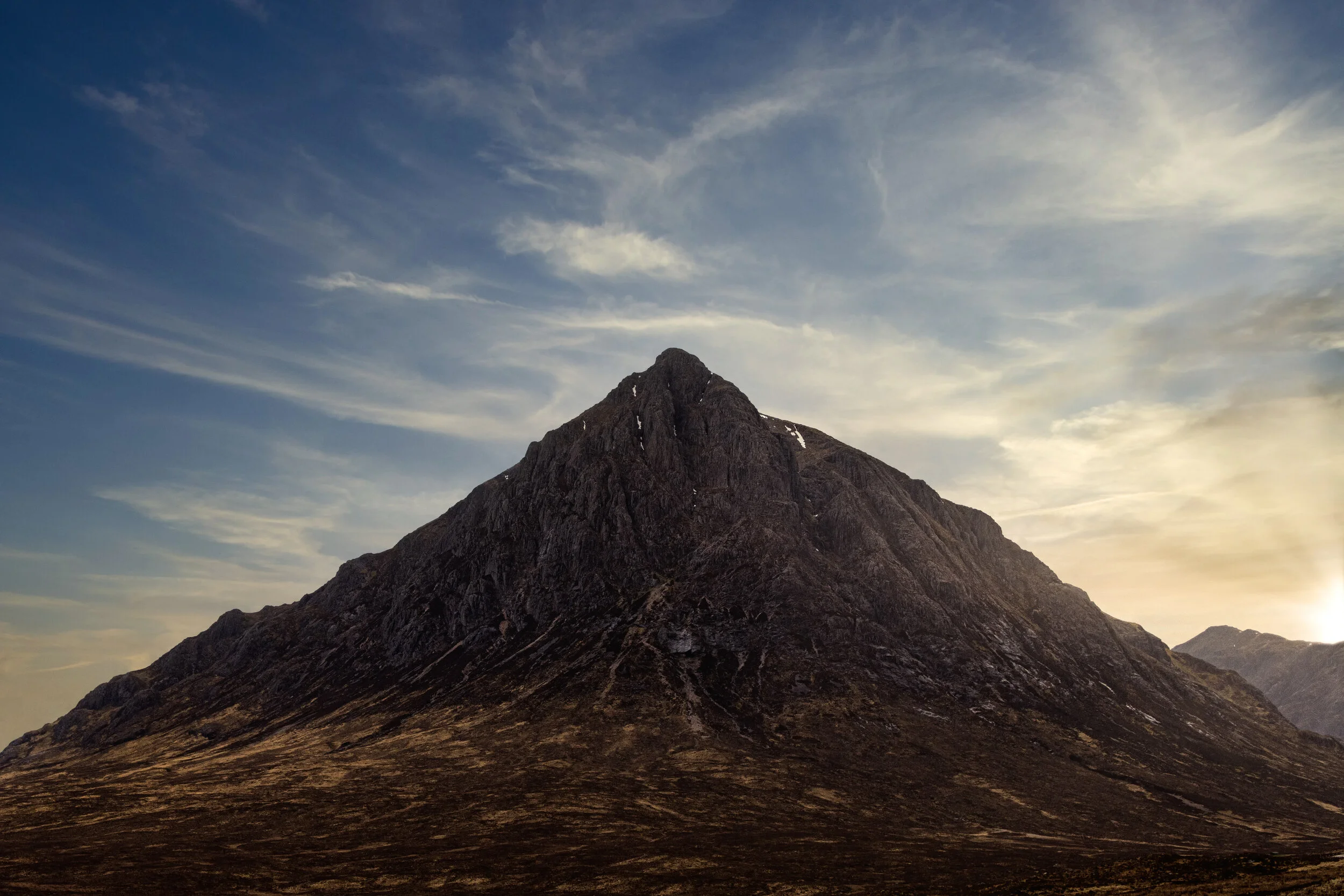
Totton had just captured the moment in Glen Coe that was the beginning of my journey to purpose and identity. I felt so small and insignificant in the Buchaile’s shadow. I imagined all of life that it had seen. How long had it been standing there? How long would it be there after I was gone? How old was the earth? In that moment it became clear to me that what I did in the world really did not matter for my time here is so short. ‘I’m not even an ‘ant’s footprint on the time line of life’ I thought.
“were we to reduce… evolution to the span of one year, we left the African Savannah a mere four to five days ago. The first civilizations developed less than a day ago. The scientific revolution clocks in at roughly one hour ago, and the digital revolution in which we are all living represents a few eye blinks.” (Palmer & Crawford, 2013, p.124)
Identity & Purpose
It was not until I studied NLP with Sue Knight in 2006 that I began to reflect on what my purpose in life might be. We were exploring Dilts’ (1988) Logical Levels of Change. My Glen Coe experience became very meaningful again;
The level of purpose is sometimes described as the level of spirituality …. What it refers to here are the larger systems of which we are a part. Understanding the spiritual level for ourselves means understanding the interconnections between us and the bigger systems. (Knight, 2002, p.211)
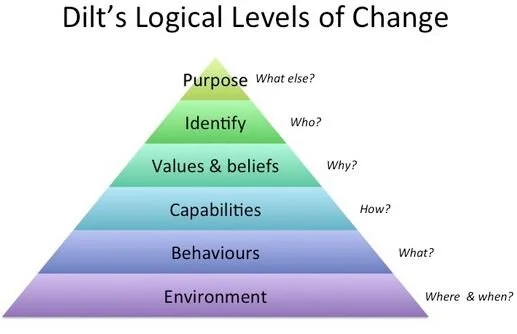
I realised that my identity was ‘I am Scottish’. Robert Macfarlane (2012) speaks about how “our minds, moods, imaginations, and identities are influenced by elements of the landscapes that we inhabit, remembered and actual”. I belong to Scotland, I am part of her and she is part of me. The adjectives that are most often used for describing Scotland could just as easily be used to describe me - the good and the bad.
And, my purpose, was to support people to reach their potential, holding the belief that this will have a positive impact for them and others they interacted with. My vision was of dropping a pebble in the sea and watching the ripples expand outwards.
It dawned on me as I wrote this that I am spiritual; “the experience of awakening to your potential and becoming more aware of your true purpose.” (Newman, 2015), and that nature had been the catalyst for me. Having found my perspective, purpose, values and true sense of self through my connection with the natural world.
To paraphrase the words of John Muir, I have found that in going out, I have also been going in.
References:
Knight, S. (2002). NLP at work: The difference that makes a difference in business. London: Nicholas Brealey Publishing
Newman, M. (2015, October 15). What they don’t teach you about mindfulness at business school. [Web log message]. Retrieved from http://martynnewman.com/what-they-dont-teach-you-about-mindfulness-at-business-school
Palmer, W. & Crawford, S. (2013). Why we do what we do. In Leadership embodiment: How the way we sit and stand can change the way we think and speak (pp. 121-154). San Rafael, CA: Create Space.
Totton, N. (2013). The practice of wild therapy. Retrieved from http://www.wildtherapy.org.uk

Lesley holds an MSc in Executive Coaching from Ashridge Business school and she has 16 years commercial experience with Mars. She holds an EMCC Senior accreditation. Read More >
She is the author of ‘Coaching Outdoors; the essential guide to partnering with nature in your coaching conversations’.
Contact by calling +44 (0) 7799 581792 or email info@coachingoutdoors.com.